
- Conservation
Explore our birding-specific websites:
- Education
- Policy
- Lands
- Centers and EventsCentersEvents
- About Us
Welcome to the newest enhancement of the Silk Farm Sanctuary All Persons Trail. This audio tour provides historical information about the site, ecological information about the surrounding habitats and features, and seasonal information about the wildlife that visits or calls the sanctuary home. We are committed to continue our efforts to protect nature for all people, working to make our programs, lands, and nature centers welcoming, accessible, and equitable to all participants and visitors. This audio tour is a component to that commitment, so that all community members have the opportunity to engage in the experiences that appeal to them.
Audio Trail Stops
Stop 1: Introduction to Silk Farm Wildlife Sanctuary
Stop 2: Bee Hotel
Stop 3: Pollinator Meadow
Stop 4: Knotweed Patch
Stop 5: ORIS
Stop 6: American Chestnut
Stop 7: Grassland Birds
Stop 8: Woodland Birds
Stop 9: Outdoor Classroom
Stop 10: Tree House
Stop 11: Stone Walls
Stop 12: Frogs and Toads
Stop 13: Spongy Moths
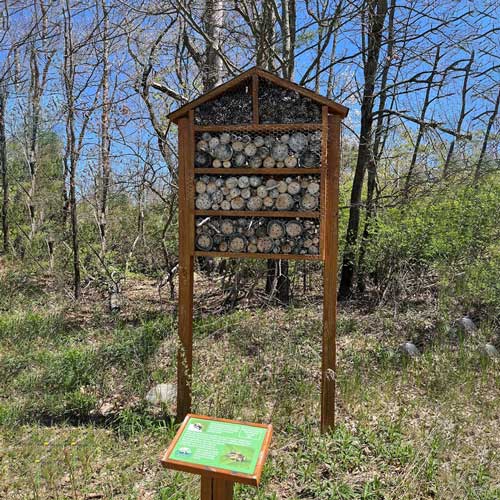
Here you have two wooden posts, supporting a bookcase-like set of shelves, and packed to the brim with twigs, pine cones, and small log cuttings with many carefully drilled holes. All this is held securely in place with a wire-mesh screen. This rather odd structure is called a Bee Hotel. The logs and twigs simulate natural cavities that bees and other insects might use to lay their eggs or for overwintering.
Some kinds of bees called social bees—including the familiar European Honey Bee and several species of Bumblebees—live in community hives among other bees. Other kinds of bees do not live in hives, but instead live solitarily. They nest in holes and natural wood cavities carved and later abandoned by other wood-boring insects. These include Mason Bees, which do not live together, but do create nests near one another. Solitary bees, just like social bees, are important pollinators. Natural nesting cavities for these bees can be scarce, and so this Bee Hotel, conveniently located next to our pollinator meadow, provides nesting habitat for these often-overlooked insects.
If you want to support solitary bees in your yard, a good way to start is by installing a small bee hotel—maybe 1ft by 1ft square—near a pollinator garden.
Reader: Chris Martin
Photos, from top: View across the pollinator meadow, by Dyanna Smith; Bee Hotel, by Dyanna Smith.